A quantitative pipeline for the identification of combinations of targets for claudin-low triple negative breast cancer reversion
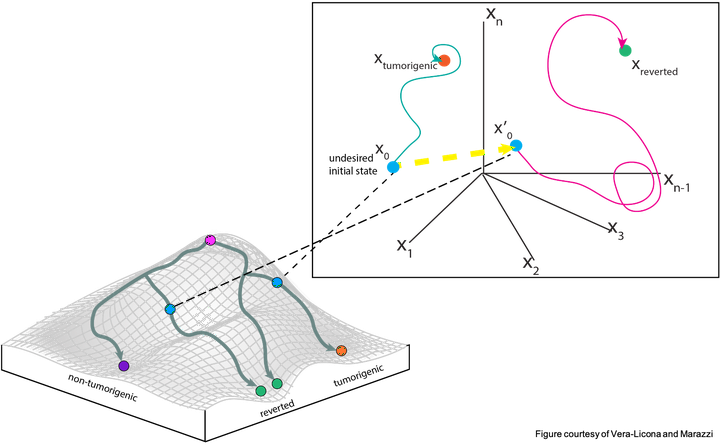 Figure courtesy of Vera-Licona and Marazzi
Claudin-Low Triple Negative Breast Cancer (CL TNBC) has high relapse and low survival rates. Due to the tumors’ decreased response to cytotoxic drugs and hormone therapy, alternative therapeutic strategies should be explored. One such strategy is tumor reversion, the biological process by which tumor cells lose a significant fraction of their malignant phenotype. Tumor reversion has been observed for over a century and has been achieved in vitro, in vivo, and ex vivo. In particular, tumor reversion has been achieved in vitro with the CL cell line MDA-MB-231, and ex vivo in mice xenografted with MDA-MB-231 cells. This project takes a dynamical systems approach to identify in silico combinations of therapeutic targets for CL TNBC reversion. An intracellular signaling network was reconstructed with multi-omics profile data for MDA-MB-231. Then a structure-based attractor-based control method for nonlinear dynamic systems was applied to the network to identify driver nodes of the system. Topological signal flow analysis was applied to the network for virtual screenings of driver node perturbations to predict their effect on the system. Combinations of nodes whose concerted perturbation resulted in the system shifting from the tumorigenic basin of attraction to the normal-like basin of attraction were deemed putative concerted reversion targets. Through this methodology, several potential combinations of targets that may shift the cell from a tumorigenic to a normal-like phenotype have been identified to be further validated in future work.

Madeleine S. Gastonguay
PhD Candidate
I am a biomedical engineering PhD candidate at Johns Hopkins with a Bachelors of Science in Applied Mathematics. I am passionate about computational systems biology research because I love building models with a fascinating and impactful application.