The impact of measurement noise in mediation analysis
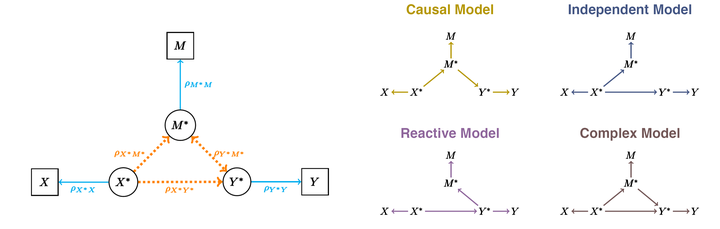
Mediation analysis focuses on inferring the relationship between an exogenous variable (X), target (Y), and candidate mediator (M). When X, M, and Y are all correlated, there are a few plausible relationships between them. In the Causal model, the effect of X on Y is mediated entirely through M. In the Independent model, there is no causal relationship between Y and M because X exerts its effect on each variable independently. In the Reactive model, the proposed mediator is downstream of the proposed target and is thus reacting to changes in Y, and in the Complex model, also called the Partial Mediation model, X effects Y both directly and indirectly through M.
Most analyses ignore measurement noise and assume that as the sample size approaches infinity, inferences made from the observed data accurately reflect the underlying structural model (ie. results are consistent). When working with real data, there will be some degree of measurement error and thus the measured variables should be thought of as shadows of the true causal variables. The left panel of the figure above shows the measurement noise model, which describes how the true causal variables (variables in circles) are causally related to each other and how they are related to their measured counterpart (variables in squares). This model is equivalent to a simpler latent variable model, which we use to show that the underlying structural model is unidentifiable without additional information about measurement noise. It is also used to explain how observed data can be generated by each structural model to identify configurations that are realistic given prior knowledge about the relative amount of measurement noise in X, M, and Y.
Through simulations of the measurement noise model, we show that each of the structural models can generate any correlations between the observed data. We identify regions of the latent variable model parameter space in which inferences will be consistent and those in which it will be inconsistent (ie. as the sample size increases so does the evidence for an incorrect inference). We show that the Partial Mediation classification can be assigned even when there is no mediation in the structural model. With examples in data from human cell lines and model organisms, we demonstrate cases where the inferred relationship disagrees with biological evidence of the underlying relationship and offer an explanation for each scenario.

Madeleine S. Gastonguay
PhD Candidate
I am a biomedical engineering PhD candidate at Johns Hopkins with a Bachelors of Science in Applied Mathematics. I am passionate about computational systems biology research because I love building models with a fascinating and impactful application.